Quick answer
Your hair type is a mix of four things: texture (straight, wavy, curly or coily), strand thickness (fine, medium or coarse), density (how many hairs you have), and porosity (how easily your hair takes in water). Texture tells you which attachments and styles suit you. Thickness tells you how much heat you need. Most people have more than one texture on one head.
Key takeaways
- Texture, thickness, density and porosity are four separate things. You need all four to pick tools well.
- Fine hair means thin strands. Thin hair means fewer strands. They are not the same.
- Most people have more than one curl pattern, and it can change over time.
- Thickness decides how much heat you need. Texture decides your attachments.
- Home porosity tests are rough guides, not exact measurements.
On this page
Most hair advice starts with “depending on your hair type”. That is not much help if you are not sure what your type is. So let’s sort it out.
Your hair type is not one label. It is four separate things, and each one changes which tools will work for you.
The four parts of your hair type
| Part | What it means | Why it matters for tools |
|---|---|---|
| Texture | The shape of your strands: straight, wavy, curly or coily | Decides your attachments and styles |
| Thickness | How wide each strand is: fine, medium or coarse | Decides how much heat you need |
| Density | How many hairs you have | Decides drying time and section size |
| Porosity | How easily hair takes in and loses water | Affects drying time and frizz |
Texture: straight to coily
Let your hair dry with no product, then look at the shape.
- Straight: no bend from root to tip. It often looks oily sooner, since oil travels down easily.
- Wavy: loose S-shaped bends. Often frizzes when brushed dry.
- Curly: springy loops or ringlets you could wrap around a finger.
- Coily: tight coils or zigzags, often very dense, and the most fragile when dry.
Many people use a number and letter system, like 2A to 4C. It is a handy shorthand, but most heads have a mix. The American Academy of Dermatology notes that Black hair in particular is especially fragile and prone to damage, so gentle handling matters 1.
Strand thickness: fine, medium or coarse
Take one hair and roll it between your finger and thumb.
- If you can barely feel it, it is fine.
- If it feels like a thread, it is medium.
- If it feels wiry or stiff, it is coarse.
Thickness is the key to heat. Fine strands heat through fast, so they need low settings. Coarse strands take longer, so they need more power but still benefit from as little heat as possible. In a lab study, heat damaged the outer layer of untreated hair and broke down its main protein at very high temperatures, and the amount of protein lost varied with hair type 2.
Density: how much hair you have
Part your hair in the middle and look in the mirror.
- Low density: your scalp shows easily.
- Medium density: some scalp shows.
- High density: you can barely see your scalp.
High density means longer drying times and smaller sections when you style. A powerful dryer like those in our thick hair list saves a lot of time.
Porosity: the water test and its limits
Porosity describes how easily water gets in and out of your hair. You may have seen the “float a strand in a glass of water” test. It is a rough guide at best, since oils and products change how a hair floats.
A more useful clue is how your hair behaves day to day:
- Low porosity: takes a while to get wet, and products sit on top.
- High porosity: soaks up water fast, dries fast and frizzes easily. Damaged and bleached hair is usually high porosity.
How your type changes which tools you need
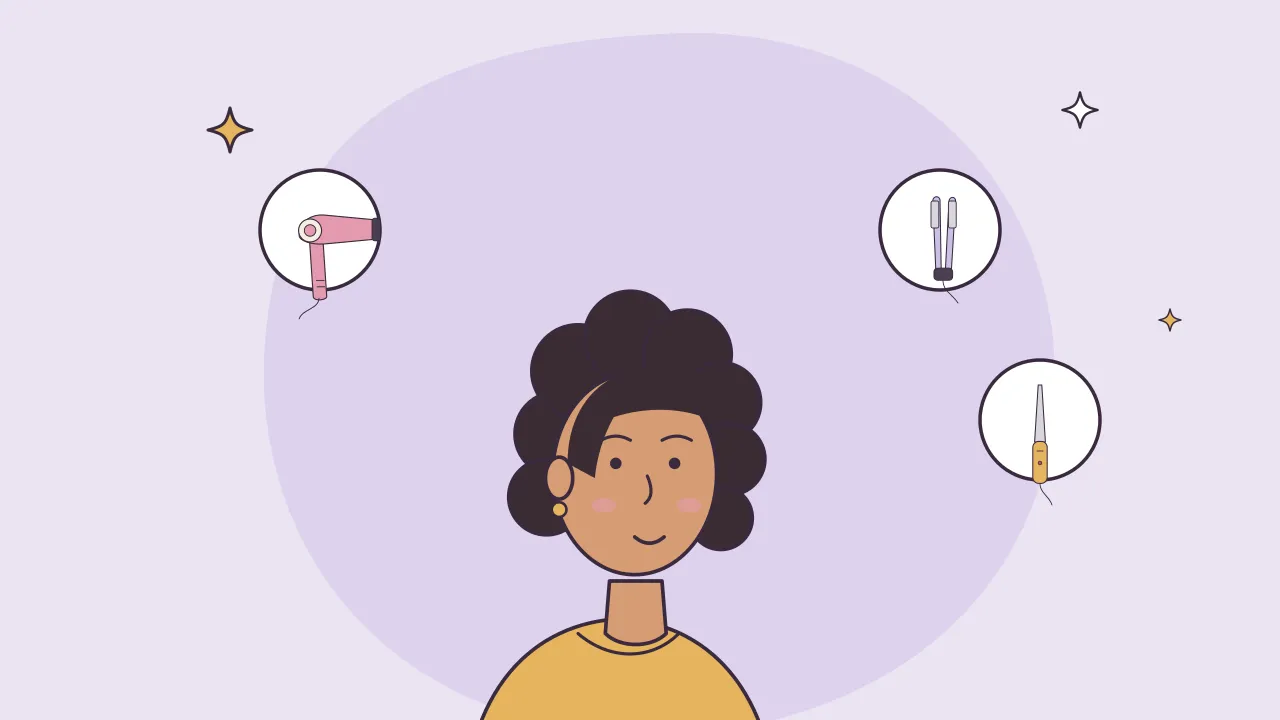
| Your hair | Hair dryer | Brush | Hot tool tip |
|---|---|---|---|
| Fine, straight | Light, low heat | Boar bristle or soft detangler | Lowest iron setting |
| Thick, straight or wavy | Strong airflow, concentrator | Paddle brush | Wide plates, fewer passes |
| Curly | Dryer with a diffuser | Curly-hair detangler | Use heat sparingly |
| Coily | Dryer with a comb | Wide-tooth comb, gentle detangler | Silk press on low to medium heat |
Want a tailored answer? The hair tool finder takes your texture, thickness and goal, then points you to the right list.
Questions people ask
How do I know my curl pattern?
You know your curl pattern by letting your hair air dry with no product and looking at the shape. Straight hair has no bend, wavy hair forms loose S-shapes, curly hair forms loops or ringlets, and coily hair forms tight coils or zigzags.
What is the difference between fine and thin hair?
The difference between fine and thin hair is that fine describes each strand, while thin describes how many strands you have. You can have fine hair that is very dense, or coarse hair that is thin. Each needs a slightly different approach.
Can hair type change?
Hair type can change over time. Hormones, pregnancy, age, medicines and heat or chemical damage can all change your texture or thickness. Many people find their curls loosen or tighten over the years.
Does the hair porosity test work?
The hair porosity test, where you drop a strand in water, is only a rough guide. Oils and products on the hair change how it floats. Watching how fast your hair gets wet and dries is often more useful.
What hair dryer is best for my hair type?
The best hair dryer for your hair type depends on thickness and texture. Fine hair needs gentle heat and light weight, thick hair needs strong airflow, curly hair needs a diffuser, and coily hair often benefits from a comb attachment.
Can I have more than one curl type?
You can have more than one curl type, and most people do. Hair at the nape is often curlier than hair at the crown. Style for the hair that needs the most care.
How do I know if my hair is high density?
You know your hair is high density if you can barely see your scalp when your hair is down and parted. If your scalp shows easily, your density is low. Medium sits in between.
Does hair type affect how often I should wash?
Hair type does affect how often you should wash. Fine and straight hair tends to look oily sooner. Curly and coily hair is often drier and may need washing less often, as dermatologists suggest for Black hair.
Sources
- 1 Black hair: Tips for everyday care . American Academy of Dermatology . Medical organization
- 2 Lima CRRC, Couto RAA, Freire TB, et al. Heat-damaged evaluation of virgin hair . J Cosmet Dermatol , 2019 ; 18(6):1885-1892 . Study