Guide
How to choose a hair dryer for your hair type
How to choose a hair dryer that suits your hair: wattage, ionic vs ceramic, heat settings and attachments explained simply, plus the habits that cut damage.
Hair tools
Every hair tool we recommend, sorted by what it does and who it suits: hair dryers, blow dryer brushes, flat irons, curling wands, brushes and heatless sets.
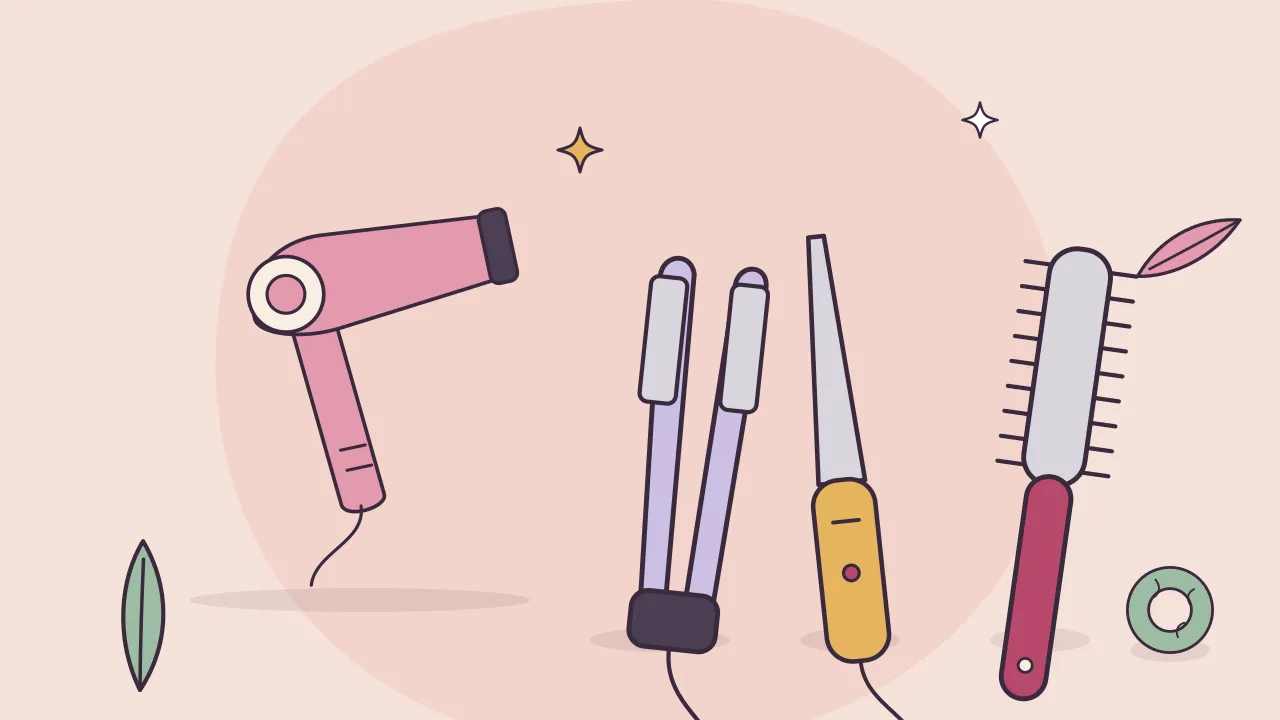
A good hair tool should make your routine shorter and your hair healthier. The wrong one does the opposite. That is why every list below is matched to a hair type or a goal, not just a product category.
Start with the shelf that fits what you want to do. Or, if you are not sure, the hair tool finder further down asks four quick questions and points you to the right list.
Fast, quiet and kind to your hair type.
A salon-style blowout in one step.
Four quick questions. You will get the tool type that suits your hair and the list to shop from.
One base, many attachments.
Smooth, sleek and less heat damage.
From beach waves to bouncy curls.
Curls with little or no heat.
Detangle without the breakage.
Steamers, heat caps, trims and more.
Silk, satin and gentle drying.
| You want | The tool that does it | Start here |
|---|---|---|
| A smooth, bouncy blowout | Blow dryer brush | Blow dryer brushes |
| Defined curls with less frizz | Dryer with a diffuser | Dryers for curly hair |
| Sleek, straight hair | Flat iron or straightening brush | Flat irons |
| Waves or curls | Curling iron, wand or auto curler | Curling irons |
| Curls with no heat at all | Satin rod or rollers | Heatless curlers |
| Fewer tangles and less breakage | Detangling brush | Detangling brushes |
Heat is the main thing that wears hair down. In a lab study of hair strands, damage to the hair’s surface went up as the dryer got hotter and closer. Yet holding a dryer about 15 cm (6 inches) away and keeping it moving caused less damage than letting the hair dry naturally 1.
So the habit matters as much as the tool. Keep hot tools moving, use the lowest setting that holds your style, and give your hair a few heat-free days. Our guide to protecting hair from heat damage walks through each step.
We start with tools that thousands of people have rated well. Then we read the newest reviews first, because a motor or a heating plate can change from one batch to the next. We also pay close attention to 4-star reviewers, since they like the tool and still tell you what bugs them. You can read more in how we choose products.
Learn first
How to choose a hair dryer that suits your hair: wattage, ionic vs ceramic, heat settings and attachments explained simply, plus the habits that cut damage.
What temperature to set your flat iron for fine, medium, thick and natural hair, why lower heat is usually enough, and the signs your iron is too hot.
How to protect your hair from heat damage: lower settings, fully dry hair, heat protectant, fewer passes and heat-free days, with what the studies show.
Curling iron vs curling wand: how they differ, which barrel size gives which curl, which is easier for beginners, and how to make your curls last longer.
How to use a diffuser on wavy and curly hair, step by step: what to put in first, the right heat and speed, hover vs cup vs pulse, and how to fix frizz.
How to do a salon-style blowout at home: rough dry, section, smooth with a round brush or blow dryer brush, set with cool air, and make it last for days.

What is your hair type? A simple guide to texture, strand thickness, density and porosity, how to test each one at home, and which tools suit your hair.
How to clean a hair brush step by step: remove hair, wash by brush type (paddle, boar, cushioned, round), dry it properly, and know when to replace it.
Which beauty tools are worth spending more on? Where a pricier hair dryer, flat iron or LED mask pays off, and where budget tools work just as well.
Do silk pillowcases help your hair? How friction affects frizz and breakage, silk vs satin, what to look for in a pillowcase, and when a bonnet is a better choice.
Dyson Airwrap vs Shark FlexStyle: how each one styles, attachments, drying, results by hair type and value, so you can pick the right multi-styler.
Hair dryer wattage explained: what watts measure, why airflow matters more for drying speed, wattage for travel and dual voltage, and what to look for instead.
How to curl your hair with a flat iron: which iron works best, the twist-and-glide method for curls, flat iron waves, the right heat, and how to make curls last.
How to get heatless curls overnight: how damp hair should be, rod vs rollers vs braids, step by step with a satin rod, and fixing frizzy curls.
The best hair tool for beginners is usually a blow dryer brush. It dries and smooths in one step, so you do not need to juggle a dryer and a round brush. If you want curls, an automatic curling iron is the easiest start because it wraps the hair for you.
The hair tool that causes the least damage is a heatless set, because it uses no heat at all. For hot tools, the gentlest habits matter more than the brand. Keep a dryer moving and a few inches away, use the lowest iron setting that works, and only iron hair that is fully dry.
You do not need a special hair dryer for curly hair, but you do need a good diffuser. A deep diffuser bowl spreads the air so curls dry in their shape instead of blowing apart. Low speed with medium heat is the usual starting point.
A flat iron is better if you want truly sleek, glassy hair, and a straightening brush is better if you want smooth hair fast. Brushes leave more body and take less skill. Irons give a flatter finish and hold longer on thick or curly hair.
A curling iron is easier for most beginners because the clamp holds the hair in place. A wand is faster once you get the hang of it, and it gives looser, more modern waves without a crimp at the ends.
You should replace a hair tool when it stops heating evenly, the plates or barrel chip, or the cord frays near the base. A frayed cord is a safety issue, so stop using it right away. Brushes need replacing when bristles bend, melt or fall out.
Expensive hair tools are worth it when you use them often and have hair that is hard to style, such as very thick or very long hair. Pricier dryers tend to be lighter and quieter, which you notice every day. For occasional styling, a well-reviewed mid-range tool is usually enough.
For natural hair, most people get the most use from a detangling brush, a dryer with a comb attachment or diffuser, and a heatless set such as flexi rods. A flat iron with steady heat is worth adding if you like a silk press now and then.
Your shortlist
Saved in this browser only. Tap the heart on any product to add it.
Nothing saved yet.
When a product catches your eye, tap its heart. Your picks wait here while you keep browsing.
Browse the listsAs an Amazon Associate I earn from qualifying purchases.