Quick answer
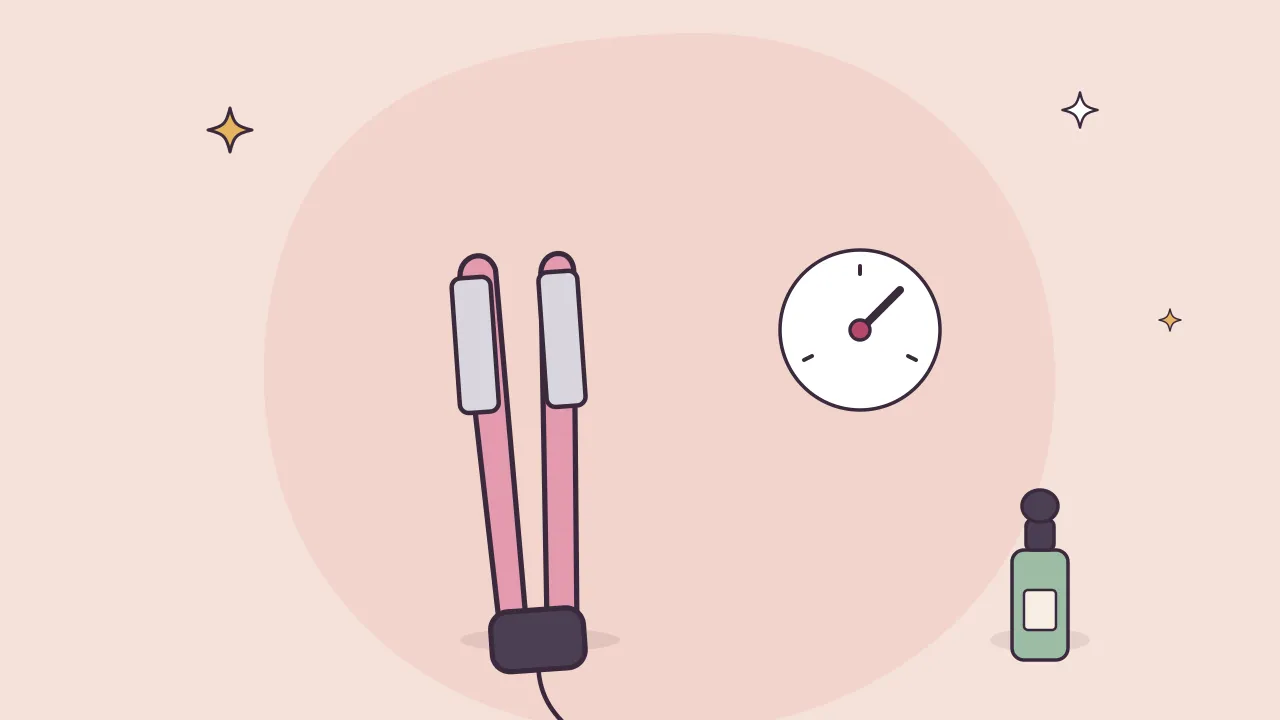
Start on the lowest heat setting that still holds your style, then go up only if you need to. Fine, colored and bleached hair needs the least heat. Thick or coarse hair can take more, but fewer slow passes are kinder than many fast ones. Always use hot irons on fully dry hair.
Key takeaways
- Fine, colored and bleached hair needs the lowest settings.
- One or two slow passes beat many quick ones.
- Keep dryers moving and a few inches from your hair.
- Never use a flat iron or curler on wet hair.
On this page
Heat setting guide
Pick your tool and your hair. We will suggest a starting setting and the habits that cut heat damage.
Starting points by hair type
Tools label their settings differently, so this guide gives you a level to start from rather than an exact number.
| Hair | Starting setting | Passes per section |
|---|---|---|
| Fine or damaged | Lowest | One slow pass |
| Fine but healthy | Low | One or two |
| Medium | Low to medium | One or two |
| Thick or coarse | Medium, higher only if needed | One or two slow passes |
| Colored or bleached | One step lower than usual | As few as possible |
Why lower heat is better
Heat roughens the outer layer of the hair. In a lab study, damage to the hair’s surface rose as dryer heat went up, while drying from about 15 cm away with constant motion caused less damage than natural drying 1. The same idea applies to irons: the less heat it takes to hold your style, the better.
So start low, move slowly, and only turn it up if your style will not hold. Our guide to protecting hair from heat damage has more tips.
Questions people ask
What heat setting should I use for fine hair?
The heat setting you should use for fine hair is the lowest one that holds your style. Fine strands heat through quickly, so they rarely need a high setting. If your hair smells hot or looks dull afterward, turn it down.
What heat setting should I use for thick hair?
The heat setting you should use for thick hair is usually medium, going higher only if the style will not hold. Work in small sections so each one heats evenly with fewer passes.
Is the highest setting on my flat iron bad?
The highest setting on your flat iron is more than most hair needs. It can make sense for very coarse hair in small sections. For everyone else, it raises the risk of dryness and breakage.
Should I use heat on wet hair?
You should not use a flat iron or curling iron on wet hair. Water inside the strand heats up fast, which can damage it from the inside. Dry your hair fully first, or use a dryer on damp hair.
How far should I hold my hair dryer?
You should hold your hair dryer a few inches from your hair and keep it moving. In a lab study, drying at about 15 cm (6 inches) with constant motion caused less surface damage than holding the dryer closer.
Does colored hair need lower heat?
Colored hair does need lower heat, because coloring weakens the outer layer of the strand. High heat can also make color fade faster. Bleached hair is the most fragile and needs the most care.
How often can I use hot tools?
You can use hot tools as often as your hair tolerates, but fewer is better. Many people do well with heat-free days each week, using heatless curls or protective styles in between.
Do heat protectants really work?
Heat protectants do help by adding a light barrier and helping tools glide, which means fewer passes. They do not make high heat safe on their own, so pair them with lower settings.
Sources
- 1 Lee Y, Kim YD, Hyun HJ, et al. Hair shaft damage from heat and drying time of hair dryer . Ann Dermatol , 2011 ; 23(4):455-62 . Study